
Tax changes and new tax rates for 2025
From 1 January 2025, a number of tax changes take effect for companies and private individuals alike. Know them all, so you can plan your finances and your taxes under the new rules.

VAT changes
VAT on accommodation and breakfast
From 1 January 2025, VAT on accommodation, including accommodation with breakfast, rises from 9% to 13%. This mainly hits the tourism sector, and the higher cost lands mostly on private consumers, but it can also affect other businesses (those not registered for VAT).
VAT on press publications
The VAT rate on press publications rises in 2025 from 5% to 9%. The aim is to bring publications more into line with other sectors.
Income tax changes
Corporate income tax
The corporate income tax rate rises from 20/80 to 22/78, which means an effective tax burden of 28.21% (previously 25%). This directly affects how company profits are taxed.
Dividend tax
The lower 14/86 dividend rate is abolished, leaving only the regular rate, now 22/78. If a company still has undistributed dividends that were taxed at the lower rate, the 7% withholding continues until they are paid out. There is no time limit on this 7% withholding.
Fringe benefit taxes
Because the income tax rate goes up, the base for calculating fringe benefit taxes – on company cars, for example – changes too. This affects companies that let employees use vehicles for private trips (vehicle use without a mileage log), and other benefits.
Personal income tax
The personal income tax rate rises from 20% to 22%. Note that if December 2024 salaries are paid out in January 2025 or later, the new rate applies.
Changes to deductions
On the 2024 income tax return, the extra deduction for a second child, the basic exemption for a spouse, and the home loan interest deduction are all gone.
Basic exemption
The basic exemption (tax-free income) is €0–654 a month. The income-dependent taper – the tax “hump” – stays in place until 2026. Pensioners get a fixed basic exemption of €776, which covers pension, salary and other income subject to income tax.
Social tax and mandatory funded pension
Monthly social tax base
In 2025 the monthly base for the minimum social tax is €820, so the tax due on it is €270.60 (33%). In 2024 the minimum social tax was €239.25 a month.
Second-pillar pension contributions
The second-pillar contribution rates are 2%, 4% or 6%.
Check which rates apply to January’s payments.
Motor vehicle tax
Who pays
Motor vehicle tax (on M1, M1G, N1, N1G, L3e, L4e, L5e, L6e, L7e, MS2, T1b, T3 and T5 vehicles) is paid by the owner or the responsible user.
The first assessment uses the data in the Transport Administration’s register (ARK) on 01.01.2025.
After that, the vehicle tax is set every year on 1 January, based on the register data on that day.
Change of owner and the annual tax
If a vehicle changes hands, the annual tax is paid by whoever is in the ARK register on 1 January. It is not split in proportion, and the current year’s tax does not pass to the new owner.
Payment schedule
The annual motor vehicle tax is paid in two installments: by 15 June (50%) and by 15 December (50%). It is collected by the Estonian Tax and Customs Board (EMTA).
Exemptions
Trucks and tractors weighing over 3,500 kg are exempt from the annual motor vehicle tax.
Registration fee
A new registration fee applies to M1, M1G, N1 and N1G vehicles. From 1 January 2025 it is paid on first registration or when the vehicle changes owner. The registration fee is collected by the Transport Administration.
Motor vehicle tax calculator
To make the calculation easier, the Transport Administration’s website has a motor vehicle tax calculator for working out a vehicle’s annual tax.
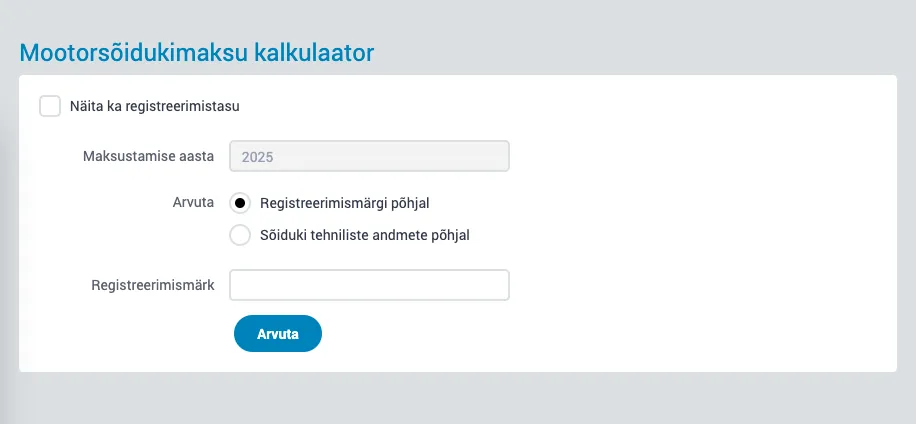
Motor vehicle tax calculator
Summary
The 2025 tax changes affect the financial planning of companies and private individuals alike. Know what is changing and prepare for it: higher VAT and income tax, new rules on dividends and fringe benefits, and the social and motor vehicle taxes.
Higher VAT and income tax, new rules on dividends and fringe benefits, and the social and motor vehicle taxes affect almost every business owner.